GAME CONCEPT & BASIC BASEBALL RULES
Baseball rules are extensive. Below, we focus on the most important basics. In our shop, you'll find literature on baseball and its rules that delve deeper into each aspect. If you're new to the game or want to understand it better as a spectator, this is a great foundation of knowledge.
BASEBALL GAME CONCEPT
Two teams play against each other, alternating between offense and defense. The defensive team is on the field and wears gloves (baseball gloves).
The offensive team (offense) tries to hit the ball into the field to give the batter enough time to reach a base. The defense tries to prevent this by catching the ball directly out of the air or getting the ball to a base before the runner arrives (after a successful hit, the batter becomes a runner).
Before a batter successfully hits the ball into the field, they must first make contact. The central, often decisive, and recurring action of the game is the duel between the PITCHER (thrower) and the BATTER (hitter). The pitcher doesn’t simply toss the ball nicely but rather tries to prevent the batter from hitting it successfully. However, the pitcher must aim the ball within the STRIKE ZONE. Helping the pitcher is the CATCHER, who crouches behind the batter and catches the ball – the catcher also indicates to the pitcher where to throw and helps with strategy. The catcher is thus a key position on the field and often acts as the coach’s extension on the field.
The strike zone is an imaginary box that corresponds to the width and depth of the home plate, floating between the batter's knees and chest. The decision on whether the ball was a STRIKE is made by the UMPIRE, who stands behind the CATCHER.
STRIKE
A strike is given when:
- the ball passes through the strike zone and the batter doesn’t swing
- the batter swings even if the ball was clearly outside the strike zone
- a FOUL BALL is hit
BALL
If the thrown baseball does not pass through the strike zone AND the batter doesn’t swing, the umpire calls a BALL.
The count refers to the number of balls and strikes during an at-bat.
After four balls in one at-bat, the batter gets a free walk to first base (BASE ON BALLS or WALK).
Strikes are also counted in the COUNT. Every (unsuccessful) swing counts as a STRIKE. Unsuccessful is defined as:
- a swing without contact
- foul balls, which land outside the side or backfield boundaries or roll out of the field before reaching the 1st or 3rd base.
If a batter already has two strikes during an at-bat, the counting changes:
- Any additional foul balls are counted as “neutral strikes” and don’t add to the count
- A further swing without contact results in a STRIKEOUT, which is an out for the defense.
The count (the tracking of balls and strikes) is shown as two numbers, with balls first and strikes second.
1 ball and 1 strike is shown as 1-1
1 ball and 2 strikes is shown as 1-2
At 3 balls and 2 strikes, this is called a FULL COUNT, meaning both sides are full, and the next pitch (except a foul ball) will trigger an event (Base on Balls, Strikeout, or Ball in Play).
STRIKE OUT
A batter is struck out if they:
- Miss the third strike thrown by the pitcher
- Do not swing at the third strike
- Hit the ball but it just grazes the bat and lands directly in the catcher’s glove (FOUL TIP)
Different scenarios when the batter hits the ball:
a) The ball is hit into the air (Fly Ball) and caught without touching the ground.
Result: The batter/runner is OUT.
b) The ball is hit into the air and lands on the ground.
Result: The batter/runner reaches first base and is SAFE unless the ball reaches first base before the runner. If the ball reaches the base first, the batter/runner is OUT. A defensive player must have contact with the base when catching the ball.
c) The ball flies over the outfield fence:
Home Run. The batter can run freely around all bases and scores a point. If other players are already on base, they can also cross home plate and score. With full bases, a Home Run can score up to four points (Grand Slam Home Run).
d) The ball is hit onto the ground (Ground Ball) and the defense throws it to first base before the runner.
Result: The runner is OUT.
e) The ball is hit onto the ground (Ground Ball) and the defense throws it to first base after the runner.
Result: The runner is SAFE.
After one OUT, the next batter steps up. The predetermined batting order (BATTING ORDER) must be followed. After 3 OUTS, the offensive team switches to defense.
Defensive player positions are strategically placed to cover the field evenly and with the greatest chance of success. The field is divided into INFIELD and OUTFIELD. Positions may shift slightly depending on the game situation, but the basic setup remains the same.
How can an OUT be made?
In addition to the previously described plays, a batter or runner is OUT if:
- A hit ball is caught directly from the air, no matter which player catches it or where it’s caught (see FAIR and FOUL TERRITORY).
- The runner is tagged with the ball while not on a base (see TAG PLAY).
- The batter swings and misses a third pitched ball (see STRIKE OUT).
Important considerations:
There is a "force play," meaning a runner must vacate the base when a subsequent batter hits the ball into play. At no point can two offensive players occupy the same base.
Example: Player A reaches first base safely. Player B hits the ball into the field, so Player A must run to second base, freeing up first base for Player B. The defense can choose to get Player A or Player B out by throwing the ball to the appropriate base. If the ball reaches the base before Player A or Player B, the corresponding player is out.
If the defense gets Player A out at second base and Player B is still running to first base, Player B can also be out if the ball reaches first base before them. This double play results in two outs during the same play.
Important note about force play: If the defense chooses to get Player A out at first base, the force play is lifted for Player B. To get Player B out at second base, they must now be tagged with the ball before reaching the base.
In this situation, Player B can decide to return to first base. In either case, a tag is required to make the out.
Game Duration
Baseball is played in innings, with no time limit. An inning ends after both teams have taken turns at bat and in defense, switching after three outs.
A typical baseball game lasts 9 innings. In Germany, league games often include doubleheaders, where the same teams play two games back-to-back. In some cases, doubleheaders are played over two days, with the first game usually taking place at night under floodlights and the second the following day.
In the German league, teams often travel long distances, so the doubleheader format allows more games to be played more efficiently. Doubleheaders are usually played as 2x9 or 2x7 innings.
SOFTBALL - Differences from Baseball
Softball is based on the same game idea as baseball and is a widely popular recreational sport, especially in the USA. As a competitive sport, it is mostly played by women and differs in several key points from baseball.
Firstly, the field is somewhat smaller, but its basic shape corresponds to that of a baseball field. However, the ball is slightly larger (12”). Contrary to the assumption that a softball is softer, it is also made of cork and leather and is hard.
Pitching motion: The pitcher must throw the ball using an underhand motion from below the hip. The arm rotates once in a "windmill" motion at the shoulder joint.
Base stealing/Lead: The runner may leave the base only with the pitch.
Bat shape: Softball bats are usually a bit thinner and lighter. The shape of baseball bats is tapered, while softball bats become bottle-shaped after the handle and then run straight. Additionally, wooden bats are generally not used.
Safety base: There is a so-called safety base at first base, which provides an extra area for the batter-runner to avoid collisions.
Further details about the rules of softball and its variations (Fastpitch / Slowpitch) can be found in the respective game regulations of the associations.
BASEBALL / SOFTBALL IN SCHOOL PHYSICAL EDUCATION AND THE GYM
Baseball may seem exotic to many. However, almost everyone has already played a very similar game in PE: dodgeball (brennball).
The idea of the game and the basic rules of dodgeball and baseball are very similar. Therefore, dodgeball is an excellent way to introduce baseball in school and learn the basics.
In dodgeball, there are different variations that can be individually adapted according to class size and performance level.
The following classic variant of dodgeball is suitable for all age groups:
The class is divided into two teams – the THROWERS and the CATCHERS. The game is played with a soft foam ball.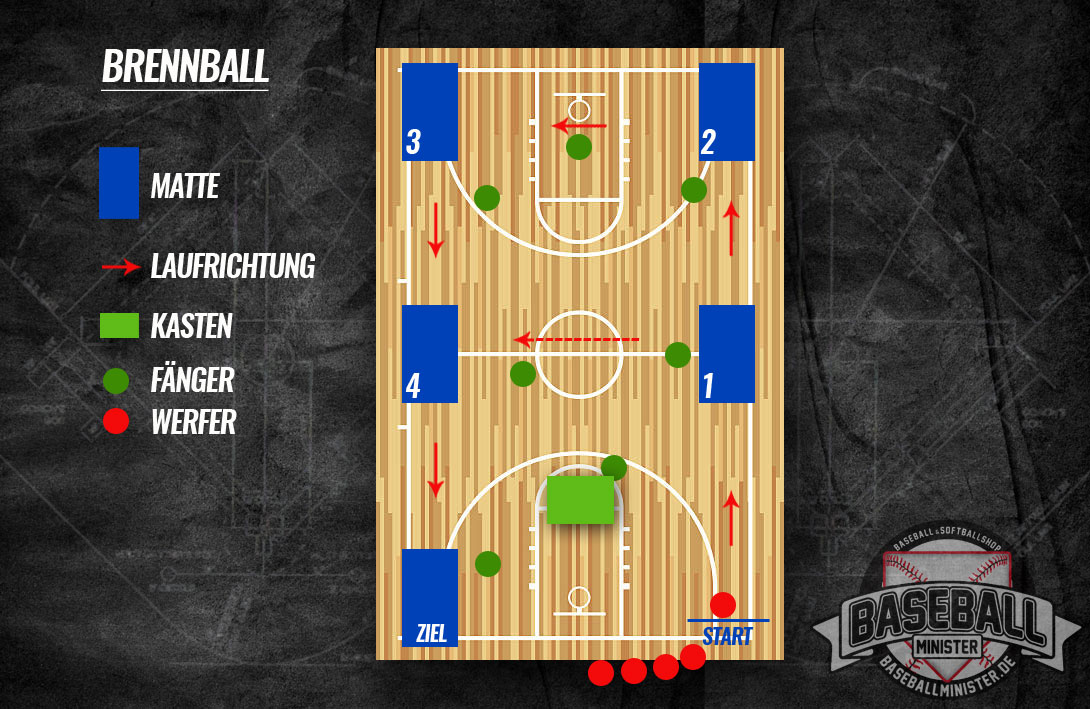
The CATCHERS spread out evenly but freely in the field. The THROWERS line up behind the starting line. They throw in turn. The first thrower throws the ball into the field and tries to reach the mats in a counterclockwise direction.
He can run until the ball is thrown to the BURNER, who bounces the ball into the overturned box. This is confirmed by a whistle from the teacher. All runners who are not on a mat (burn mark) at the time of the whistle are out.
They line up again behind the starting line. If a runner is on a mat at the time of the whistle, they are SAFE and may wait for the next thrower’s turn. Once the ball is in play, all throwers on the field can continue running.
The rules remain the same with multiple runners (throwers) on the field: Anyone not on a mat at the time of the whistle is out.
Every thrower who reaches the target mat scores a point. If a thrower manages to circle all the mats with their throw, they score three points (Home Run).
After each thrower has made a predetermined number of throws, the teams switch, and the catchers throw.
----
To play proper baseball in the gym, changes to the gameplay are necessary (compared to outdoor baseball or dodgeball).
Additionally, the gameplay is slightly adjusted to meet school requirements, so that even inexperienced students can enjoy the game and quickly improve their technique.
The field is scaled down to make baseball playable in a standard single gym. Depending on the available space, the field can also be extended to a double or triple gym.
In a single gym, the home plate is positioned in the lower left corner, so that the path to third base forms the longest line. The distance between the bases should be around 9 meters. The game is played in a clockwise direction.
The following changes to the rules and gameplay are made for playing baseball in the gym:
There is no pitcher. The ball is tossed to the batter – thrown from a short distance from the side. Alternatively, the baseball can also be hit from a BATTING TEE.
Each batter has three attempts to hit. If the batter does not hit the ball or does not hit it into the field, the batter is OUT. The ball may not be deliberately hit short onto the ground.
After a successful hit, the batter (who then becomes a runner) tries to reach first base before the defense throws the ball to the player at first base. The classic baseball rules apply here.
Important: The baseball bat must be placed in a box that is about one-third of the way to first base. If the bat falls out, the runner must turn back and put the bat back in the box. The defense thus has more time for the play.
If the ball is caught in the air (even after hitting a wall, curtain, teammate, glove), the batter is OUT.
If the baseball touches the ceiling or a ceiling structure, the batter is OUT.
The next batter comes to the plate and gets three attempts to hit. The pre-set batting order (BATTING ORDER) must be followed.
With a successful hit into the field, all runners already on base must advance (FORCE PLAY).
Each runner who crosses home plate scores a point for their team.
Important: The home plate must be touched with the hand.
Optional special rule: If the ball hits the basketball backboard directly (without touching the wall/ceiling/floor), it counts as a Home Run. The batter and all runners on base may round the bases and score one point each (RUN).
At no point may two runners be on the same base.
Sliding: Only HEAD FIRST slides are allowed. Sliding feet first is not permitted. Any runner sliding feet first is immediately OUT.
KEY TERMS & BASEBALL FAQ
BATTER
The player who attempts to hit the ball into the field. The batter stands next to home plate in the batter's box, which they are not allowed to leave during the swing.
BATTING ORDER
Batting lineup. This must be determined in advance and cannot be changed during the game without reason. Typically, fast and reliable hitters bat in positions 1 and 2, followed by strong hitters in positions 3 and 4 who can ideally score the first runs.
In a new inning, the player who follows the last player to be put out in the batting order starts. The performance-based setup of the batting order is thus only guaranteed in the first inning.
HIT BY PITCH
A batter is hit by the pitch thrown by the pitcher.
INNING
A game segment. Each team has one turn to bat (offense) and one to play defense per inning. The batting turn lasts until the opposing team has made 3 outs. The teams then switch to defense.
BASE
There are three bases placed in the infield, which must be run counterclockwise after a successful hit: first base, second base, third base.
As long as a player is in contact with the base, they are safe and cannot be put out.
See also: Out and Safe.
OFFENSE
The attacking team with the right to bat.
DEFENSE
The defending team.
RUN
A point. A player from the attacking team scores a point by crossing home plate, after having touched bases 1-3.
RBI (Runs Batted In)
Runs driven in. If player A reaches home plate and scores a point due to a hit by player B, player B is credited with an RBI (run batted in) in the statistics. RBIs are purely statistical and do not directly affect the game score.
See also: Sac Fly.
ERROR
Fielding error. If an attacker reaches a base safely due to a fielding error, the fielder responsible is marked with an error (E) in the statistics. Common errors include: failing to catch an easy flyball, missing or mishandling a groundball, or making a bad throw to the base.
FIELDING
Fielding a hit ball, typically with a baseball glove.
GLOVE
The baseball glove. The gloves of first basemen and catchers are referred to as a mitt.
BAREHAND
Fielding a hit ball without using a glove – with the bare hand.
GROUNDBALL
A ball hit on the ground. Infielders, in particular, practice fielding groundballs intensively, as they are primarily responsible for these balls.
FLY OUT
A ball caught out of the air that leads to an out. Any ball caught directly, without first hitting the ground, results in an out – even in foul territory.
FLYBALL
A ball hit into the air.
SAC FLY
A ball hit into the air that is caught (out), but still allows a run to be scored (see also RBI).
SCORER
The official who records the game plays, points, and substitutions on a score sheet. The scorer also ensures that the batting order is followed.
DIAMOND
The name for the baseball field.
STEAL
Runners have the right to advance to the next base at their own risk. This usually happens when the pitcher begins their throwing motion, which they cannot interrupt, creating a small window for the runner to "steal" a base. Since the runner does this without a force play, the defense must tag the runner with the ball before they reach the base (TAG PLAY).
OUT
The goal of the defense is to get the offensive players OUT. If they succeed in getting three players out, the offensive turn changes. An OUT is made when:
- A ball is caught directly from the air
- The ball is thrown to a base before the runner arrives (observe rules on FORCE PLAY)
- A runner is tagged with the ball before reaching a base (observe rules on TAG PLAY)
FIELDER'S CHOICE
A Fielder's Choice is recorded by the SCORER when a fielder picks up the ball and, instead of getting the BATTER-RUNNER out at first base, chooses to put out another RUNNER at a different base. The batter reaches first base due to the fielder’s choice – the decision to get an out at another base.
The umpires on the field make normal calls of out or safe. The fielder’s choice is only a statistical value.
The situation described is the classic case of a fielder’s choice. There are also other variants, which are outlined in the rules and scorer regulations of the respective leagues.
BUNT
A batting technique in which the ball is not hit but "laid" into the field. In the classic version (Sacrifice Bunt), the batter "sacrifices" themselves to advance one or more runners. These runners move forward on the batter's short hit, and the batter is put out at first base. It is important that the runners are aware of the play in advance and gain a positional advantage at the start of the pitch.

SAFE
A runner reaches a base safely.
STRIKE ZONE
The strike zone is the area over home plate that the pitcher's ball must pass through to be considered a STRIKE. The strike zone is an imaginary box, the width and depth of home plate, and its height is between the batter's knees and chest. Whether a pitch is a STRIKE is determined by the UMPIRE, who stands behind the CATCHER. 
STRIKE
A strike is given when:
- The ball passes through the strike zone and the batter does not swing
- The batter swings, even if the ball is clearly outside the strike zone
- A FOUL BALL is hit
STRIKE OUT
A batter is out on strikes when they:
- Miss the third strike thrown by the pitcher
- Do not swing at the third strike thrown by the pitcher
- Hit a foul tip on the third strike that lands directly in the catcher’s glove (FOUL TIP)
COUNT
The count is the number of balls and strikes during an at-bat.
AT BAT
A batter gets an official at-bat when they attempt a hit and reach base (HIT), reach base due to a fielding error (ERROR), a fielder’s choice is made, or the batter is put out for reasons other than a SAC FLY or SAC BUNT.
BASE ON BALLS
If the pitcher misses the strike zone four times within a count, the batter is awarded a WALK or BASE ON BALLS. The batter may advance to first base without another attempt to hit.
WALK
See BASE ON BALLS.
CATCHER
The catcher crouches behind home plate and catches the pitches from the pitcher. Due to the proximity to the batter and the hard-thrown pitches, the catcher wears protective gear including a helmet, face mask, chest protector, and leg pads. The catcher is one of the most important players on the defensive team for the following reasons: They form a close unit with the pitcher (BATTERY) and decide the pitching strategy. Additionally, the catcher has the entire field in view and directs the positioning of the other fielders.
PITCHER
The pitcher is the thrower and the central player of the defensive team. The pitcher throws the ball to the batter and tries to prevent successful hits by using precise and varied pitches.
Typically, pitchers have an array of different pitches that are used depending on the batter's strengths and weaknesses.
The standard pitch is the FASTBALL, a very fast pitch that barely changes its trajectory.
Fastball variants include the 2-seam or 4-seam fastball – depending on whether the ball rotates over two or four seams. Other fast pitches include the CUTTER and the SINKER. Slower pitch variations are the CHANGEUP and the KNUCKLE BALL, which is also considered a breaking ball due to its unpredictable flight path. Other breaking ball types include the classic CURVE BALL, SLIDER, SLURVE, and SCREWBALL.
FOUL TERRITORY
The area outside (to the sides and behind) the foul lines.
FOUL BALL
A ball hit into foul territory, falling outside the foul lines or rolling out of play before reaching first or third base.
UMPIRE (colloquially Ump or Blue)
The referees in baseball & softball are called umpires. One umpire acts as the plate umpire and judges the pitcher’s throws for balls and strikes as well as plays at home plate. This umpire stands behind the catcher.
The field umpire stands in the field and makes safe or out calls at the bases. If there are multiple runners on base, the plate umpire may also make calls at the bases (e.g., third base). In professional leagues, there are often four umpires: one plate umpire and three field umpires.
HOME RUN
A ball is hit by the batter over the outfield fence. The batter and all runners on base may cross home plate. If all bases are occupied and the batter hits a home run, it is called a GRAND SLAM home run, earning 4 points (RUNS) – the maximum points possible in a single play.
MOUND
The round pitching mound from which the PITCHER throws. It is placed exactly in the center of the infield with a diameter of 5.50m. The height varies between 40 and 50cm. On the mound is the pitcher's plate – a 60x15cm plate that the pitcher must touch during their pitch. The pitcher's plate must be 18.44m (60 feet 6 inches) from the back of home plate and aligned with home and second base.
HOME PLATE
Home plate is a 43cm wide plate where the BATTER stands and hits the pitches thrown by the PITCHER. The dimensions of home plate define the STRIKE ZONE, which the pitch must pass through for a strike to be called.
Home plate is also the target for every RUNNER aiming to score a point. To score, the runner must touch home plate.
PITCH
A pitch is the throw by the pitcher to the batter. The more varied the pitches, the harder it is for the batter to hit. The pitcher aims to throw the ball into the strike zone while also placing it in such a way that the batter struggles to make contact (or is deceived into thinking the ball will pass through the strike zone). Various grip and throwing techniques are required to manipulate the ball's trajectory.